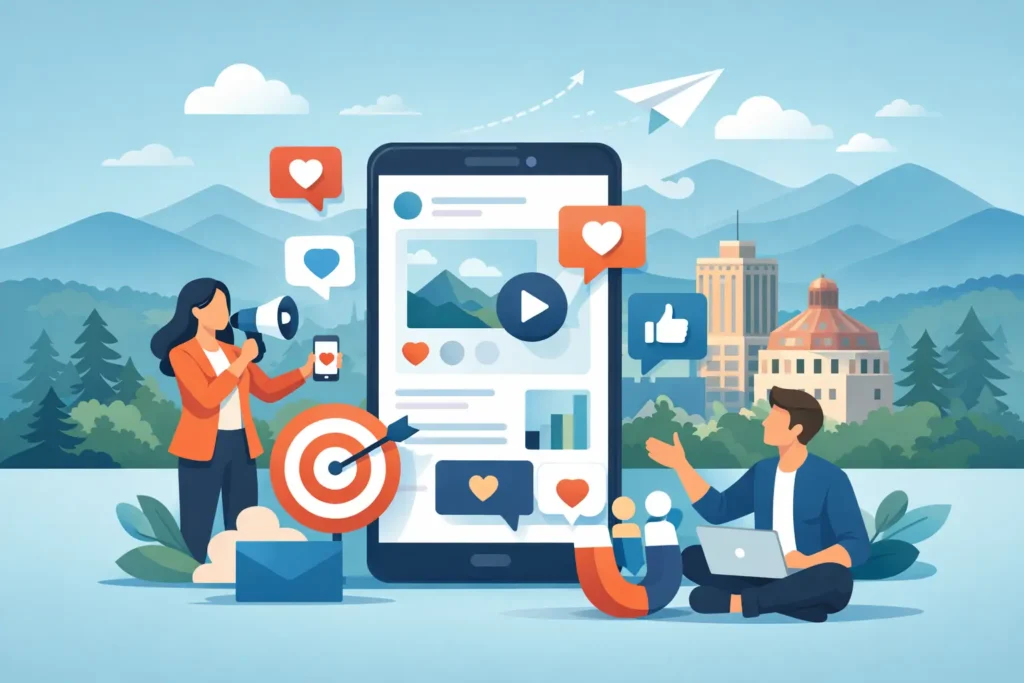
A weak social presence is expensive in a market like Asheville. If your business blends into the feed, posts without a clear strategy, or treats social as an afterthought, you are handing attention to competitors every single day. Social media marketing Asheville businesses need is not about posting more for the sake of activity. It is about building visibility that turns into trust, traffic, and revenue.
Asheville is a crowded, personality-driven market. Restaurants, wellness brands, home service companies, tourism businesses, law firms, medical practices, real estate teams, retailers, and regional B2B companies are all competing for the same thing – attention. The brands that win are the ones that show up consistently, look sharp, say something worth hearing, and connect that attention to a real business goal.
Why social media marketing in Asheville is different
This market has range. You have hyper-local businesses serving a few ZIP codes, regional companies working across Western North Carolina, and brands trying to attract tourists, second-home owners, and relocating families. That changes the way social strategy should be built.
A downtown restaurant needs one approach. A contractor in Hendersonville needs another. A medical spa in Fletcher, a boutique hotel in Asheville, and a B2B firm selling statewide do not need the same content mix, posting cadence, or ad strategy. Anyone selling social media as a plug-and-play package is skipping the part that actually drives performance.
Asheville also rewards authenticity, but not in the lazy way people talk about online. Authentic does not mean random phone photos and captions with no point. It means your brand voice is clear, your visual identity is recognizable, and your content reflects what makes your business worth choosing. That takes strategy, not guesswork.
What social media marketing Asheville businesses actually need
Most businesses do not have a content problem. They have a positioning problem.
If your social media is inconsistent, flat, or ignored, the issue is usually one of three things. Your message is too generic. Your content is not built for the audience you want. Or your social activity is disconnected from the rest of your marketing, which means it gets attention but not action.
Strong social media marketing starts with business objectives. Do you need more foot traffic, booked appointments, qualified leads, stronger local awareness, better recruiting, or stronger brand authority? The answer shapes everything from platform choice to creative direction.
A local retail brand may need short-form video, creator-style product features, and event-driven content that gets people in the door. A law firm may need trust-building educational content, reputation support, and paid campaigns aimed at high-intent local audiences. A regional service company may need social content that supports SEO, email, paid ads, and website conversions instead of trying to carry the entire marketing load alone.
That is the difference between posting and performance.
The platforms matter, but strategy matters more
Businesses ask all the time which platform matters most. The real answer is less exciting and more useful: it depends on who you want to reach, how they make buying decisions, and what kind of content your team can realistically execute well.
Instagram still matters in Asheville, especially for visual brands, hospitality, wellness, food, tourism, retail, and lifestyle-led businesses. It is strong for brand perception and local discovery, but weak execution shows fast. If your feed looks inconsistent or your Reels feel forced, people notice.
Facebook remains valuable for many local businesses, especially for community visibility, events, service providers, older demographics, and paid audience targeting. It is not trendy, but it still produces results when used with intention.
LinkedIn is often underused by Asheville B2B companies, professional services, consultants, and leadership teams. If your business sells expertise, trust, or long-cycle services, LinkedIn can outperform flashier platforms because it supports authority and relationship-based buying.
TikTok can work, but not because everyone says it should. It works when the brand has a strong angle, a clear audience fit, and content that feels native to the platform. For some local businesses, it can be a breakout channel. For others, it is a distraction.
The wrong move is trying to be everywhere with mediocre content. The better move is to dominate the platforms that align with your audience and your sales process.
Content that gets attention is not enough
Vanity metrics can keep a weak strategy alive for months. A post gets likes. A Reel gets views. A team feels productive. But if nobody clicks, inquires, books, buys, or remembers your brand when they need your service, the content is not doing its job.
Good content earns attention. Great content moves people.
That means your social media should be built around a few distinct jobs. Some content should stop the scroll and build awareness. Some should establish credibility. Some should handle objections. Some should create urgency. Some should convert. If every post sounds the same, looks the same, or asks for the sale too early, performance stalls.
This is where many businesses in Asheville get stuck. They post polished visuals with weak messaging, or they lean on personality without any strategic structure behind it. The fix is not more content. It is smarter content with a clear role.
Paid social is where momentum gets faster
Organic reach matters, but it is not a growth plan by itself. If you want to expand visibility, accelerate lead generation, or get your offer in front of the right local audience consistently, paid social should be part of the mix.
The key is targeting and creative alignment. Running ads without strong content is like paying to amplify a weak pitch. You might get impressions, but not results. On the other hand, when audience targeting, messaging, landing pages, and visual creative work together, paid social can become one of the fastest ways to test offers, improve conversions, and scale what is already working.
This matters in competitive categories across Asheville and Western North Carolina, where multiple brands are fighting for the same local demand. Paid social gives you more control over visibility instead of waiting for the algorithm to be generous.
Social media should work with SEO, PR, and your website
One of the biggest mistakes businesses make is treating social as its own isolated channel. That usually leads to scattered messaging and wasted opportunity.
Your social media should reinforce your brand positioning, support your search visibility, strengthen public perception, and send traffic to a website that can actually convert. If your Instagram is sharp but your website is outdated, you create friction. If your content builds interest but your brand story is inconsistent across platforms, trust drops. If your PR gets attention but your social channels feel inactive, momentum fades.
The businesses growing fastest are not relying on one tactic. They are building marketing systems that work together.
That is why execution matters so much. A strong strategy on paper means nothing if content creation stalls, approvals drag, campaigns launch late, or reporting never connects to actual business outcomes. Social media is not a side project. It is a visibility engine, and it needs to be treated like one.
How to tell if your current social strategy is underperforming
If you are posting consistently but not seeing business impact, the signals are usually obvious. Engagement is shallow. Reach is unpredictable. Leads are inconsistent. Your team is spending time on content without confidence that any of it is moving the needle.
Sometimes the issue is creative quality. Sometimes it is targeting. Sometimes the brand has outgrown DIY marketing but is still operating like a startup. And sometimes the business simply needs senior strategy, stronger systems, and a team that can execute without excuses.
That is where an agency partner can make the difference, especially one that understands the local market and knows how to tie content to revenue. For businesses in Asheville and across WNC, G Social Media approaches social the way it should be approached – as a growth channel, not a posting schedule.
What winning looks like
Winning on social does not mean chasing every trend or going viral once. It means your brand becomes recognizable, your message gets sharper, your audience grows with the right people, and your social presence contributes to measurable business growth.
For some businesses, that looks like more booked consultations. For others, it means stronger event turnout, better brand recall, improved recruiting, higher ecommerce sales, or more inbound leads from local audiences. The right strategy depends on the goal, but the standard is the same: your social media should produce momentum.
If your business is serious about growth, treat social media like a performance channel. Build the strategy. Get the creative right. Stay consistent. Measure what matters. Then push harder where the results show up.
Asheville is full of brands with potential. The ones that stand out are the ones willing to be clear, visible, and relentless about growth.





Comments are closed.